8: Right tool, wrong shed
In the last email (subject: Square pegs), I shared a story about an opportunity to help a sales team increase sales by $300k each year by improving their onboarding process.
Call me naive, but I assumed my manager would be as excited as I was. After all, measurable opportunities to improve performance are few and far between.
But whilst he could see the value, he wasn’t convinced.
He just couldn't justify having his primary L&D resource focused on a project that would only benefit one team. He’d already committed to several other initiatives, including a leadership development program and an enterprise-wide rollout of LinkedIn Learning.
‘Redesigning workflows’ just didn’t seem like L&D’s job.
It was at that moment the problem dawned on me: HR is often measured by workforce readiness rather than operational performance.
Many of HR’s established measures focus on retention, internal mobility, career progression, engagement, wellbeing and participation. And whilst important, these are not direct measures of performance. Performance is downstream - it emerges from a combination of capability, work design, systems, incentives and leadership.
With those being the measures my manager was accountable for, why wouldn’t he prioritise broader training programs and enterprise learning platforms ahead of solving a specific team’s problem?
So, whenever L&D sits within a function whose primary objective is not operational performance, there will continue to be a subtle emphasis on solutions that seem logical, but may not address the root cause.
Now, this might throw up an objection - don’t we need our workforce to be ‘ready’ in order to drive performance?
Well, it seems sensible - but is that backwards? Does performance improve because people are ready? Or do people become more capable, confident and engaged when the conditions enable them to perform?
Because when the conditions are designed to help people perform, their capabilities increase. That builds confidence. And they become more engaged.
And so, if that’s true, we may need to adjust things slightly…
Ladies and gentlemen, it gives me great pleasure to introduce you to:
Ant Pugh’s (Entirely Impractical) Blueprint for Organisational Restructure!!
And it all begins by unbundling, renaming and redistributing L&D:
Unbundle. Performance consulting helps analyse root causes and recommends solutions. Work design defines the work and designs the conditions for people to perform. Learning experiences shift mindsets and build skills. Currently, L&D is expected to do all three, despite each having a different objective. But because of legacy expectations, problems are often seen as knowledge or skill related. And so, unbundling these responsibilities would reduce this problem.
Rename. Once unbundled, each role should be renamed according to what it’s responsible for - performance consulting, work design and learning experience design. This would stop stakeholders assuming every problem needs training, and give each specialist a clearer mandate.
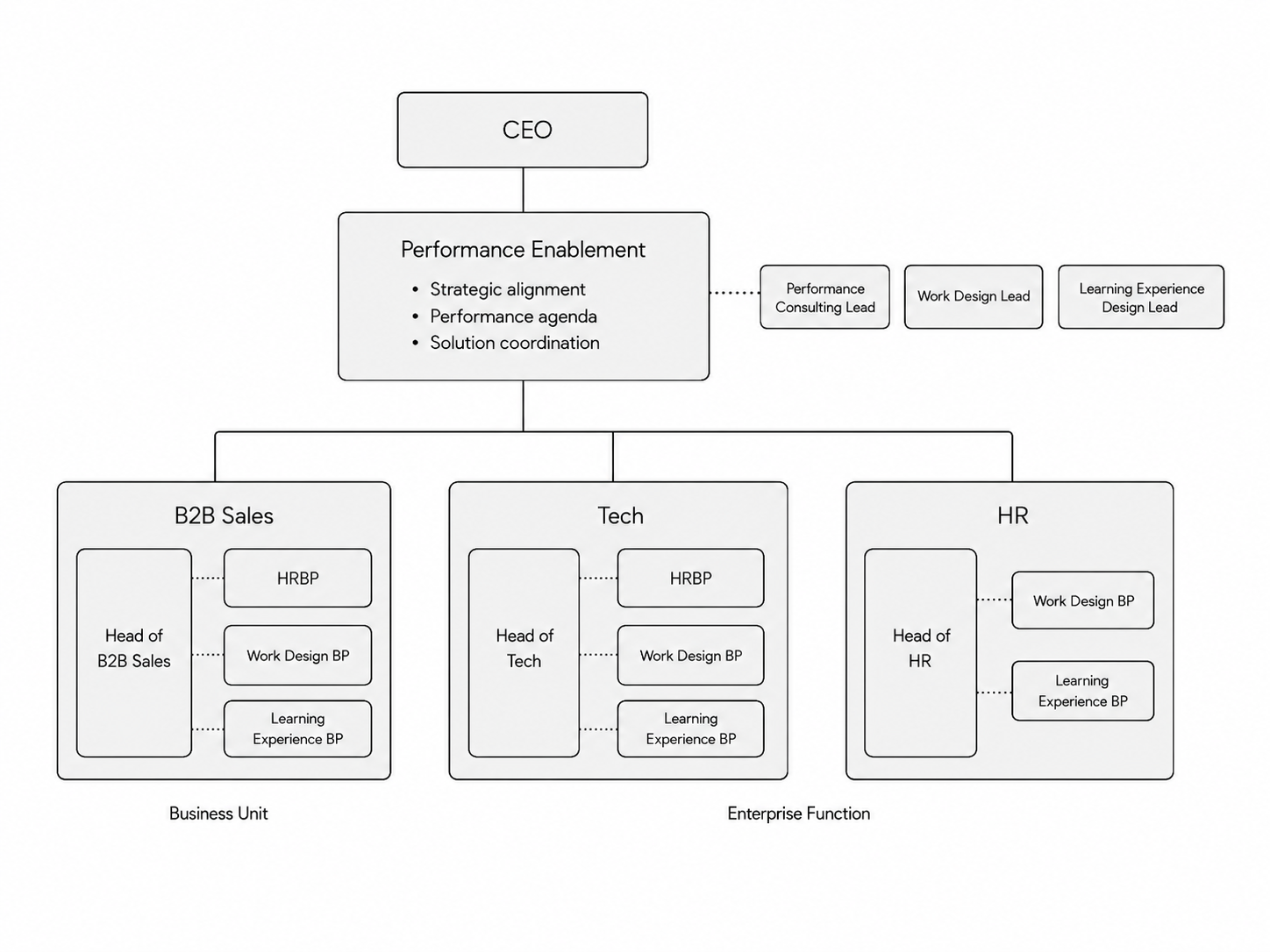
Redistribute. This is the big one - a new performance enablement function should be introduced, with authority to work across HR, sales, marketing, tech and operations. This would allow them to coordinate a broader range of responses - be that resource allocation, workflow redesign, tech consolidation, automation or training. And then, work design and learning specialists could sit inside the business units - just like an HR business partner.
So, the new structure might look something like the image below. In this model, a central performance enablement function translates business strategy into a performance agenda. Enterprise capability leads maintain the standards for performance consulting, work design and learning experience design, while embedded specialists apply those capabilities within the business units and functions.
Now, unless you have an especially good relationship with the powers that be, most of us are unlikely to influence this type of organisational change.
But understanding this is important - otherwise, we talk past each other. Every day, I see variations of the following question on LinkedIn: “Is it L&D's job to build capability, redesign work or improve performance?”
But to try and answer is to miss the point. These are different responsibilities, and each needs the right mandate, authority and proximity to the work.
So, being able to articulate these constraints helps others understand the problem and drives a better conversation about solving it.
And as AI continues to highlight the importance of work design, I suspect organisations will gradually reassess how they’re structured.
But until then, we gotta keep plugging away. Great practitioners can still create impact inside existing systems. And whilst things won’t change overnight, we can influence those around us.
More soon,
- Ant